For several years now, the future of the Kanata Golf and Country Club lands has been a central issue for residents of Kanata North. What began in 2018 as a development proposal by ClubLink has since evolved through a series of legal, planning, and municipal reviews, involving residents, the Kanata Greenspace Protection Coalition, community associations, City of Ottawa staff, my Council colleagues, legal representatives, and – of course – the courts.
A lot has happened these past couple of weeks, and I wanted to share a quick update with our community – providing answers to the many questions my team and I receive. This update focuses on where the file stands today, including court decisions, city actions, and next steps, to help you stay informed.
Where can I see the Curry/Gower motion that was brought before Council?
On January 14, I brought forward a Notice of Motion to clarify the City’s Position on the Kanata Lakes Golf and Country Club Lands. This motion gives all staff at the City of Ottawa clear direction by Council to do everything in their power, and within the law, to preserve this community greenspace. The full motion can be found here.
How did Council vote on this motion?
On January 28, 2026, Ottawa City Council passed the motion that I brought forward (with a final vote of 21-3 in favour of the motion), seconded by Councillor Glen Gower. A huge thank you to all concerned residents who took the time to send supportive letters and emails to my Council colleagues. You can read my detailed update here.
Is Ottawa Community Housing involved in this development?
No. One City Councillor, who also sits on the Ottawa Community Housing Board, wrote back to residents who wrote to her about preserving Kanata greenspace indicating that she would introduce OCH planners to residents as she would like to see increased supportive housing built. When the CEO and the Chair of Ottawa Community Housing became aware of these comments, they clarified that OCH has not been involved in anything to do with this development. It was also clarified that, as Boards work, no individual board member has the authority to direct an organization’s staff or the organization’s work plan without Board approval.
What did the Ontario Land Tribunal (OLT) decide regarding ClubLink’s application?
The Ontario Land Tribunal issued a decision granting ClubLink’s request to approve its Final Decision following the January 14, 2026 hearing. This allows ClubLink to move forward procedurally with multiple parts of its development applications at the same time, rather than sequentially.
Does the OLT decision mean that development can now proceed?
No. While the OLT decision supports ClubLink’s request to advance its filings, all outstanding conditions must still be met before any development can proceed. The decision reinforces that 192 conditions remain in place.
What kinds of conditions still need to be satisfied?
Many of the remaining conditions relate to stormwater management approvals, which are critical for environmental and infrastructure planning. Other key conditions include addressing mercury contamination issues on the site, NCC approval, MVCA approval, and City of Ottawa’s permission to use City easements. The City has told the developer repeatedly that it will not allow the developer easements to use City infrastructure.
Does this development require use of City easements?
When any new subdivision is being built, the developer isn’t only creating private lots—they’re also building the public infrastructure that every future homeowner will rely on. Much of that infrastructure needs to connect to, pass through, or tie into existing City easements.
What Is a City Easement?
A city easement is a strip of land—often along the edge of a property or underground—where the City has the legal right to install and maintain public services.
These services include:
- Water and sewer pipes
- Stormwater drainage
- Hydro, gas, or communications
- Sidewalks or pathways
- Access routes for maintenance
The land is still privately owned, but the City must be able to get to it when needed.
Why do developers need these easements?
When building a suburban subdivision, a developer generally connects all new homes to the City’s existing systems. Those systems often run through city easements. Without access to City infrastructure via easements, the subdivision simply couldn’t function.
A developer needs access so that they can:
1. Connect new homes to essential services
Water, sewage, stormwater, and utility lines in new subdivisions need to link into the City’s existing network, which often runs through easements.
2. Extend or upgrade City infrastructure
Sometimes the pipes or drainage systems in the easement need to be expanded or modernized to support the new neighbourhood.
3. Meet safety and engineering standards
Engineers design subdivisions so that services flow properly and emergency access is maintained. This often means running infrastructure through or adjacent to easement areas.
4. Ensure long‑term maintenance access
Once the subdivision is complete, the City will need to access these easements for decades—so infrastructure must be installed in the correct place from the beginning.
Example: Imagine building an addition on your house—you still need to connect your new bathroom to the existing plumbing. The connection point is usually in a place you don’t fully control, like behind a wall. The developer is doing the same thing: connecting the new neighbourhood to the City’s “plumbing,” which runs through easements.
Without access to city easements:
- Homes couldn’t get water or sewer service
- Stormwater could not drain properly
- Utilities couldn’t be installed safely
- The City might not be able to maintain its own infrastructure in the future
In short:
A subdivision cannot function without tying into the City’s existing services, and those services almost always run through easements.
What is the practical impact of this OLT decision then?
The decision mainly affects the process and timing, allowing ClubLink to pursue several approval streams simultaneously. However, it does not change the substance of the conditions/requirements — the developer must still meet all technical, environmental, and regulatory conditions before any development can legally begin.
Why was there work being done on the golf course lands on January 23?
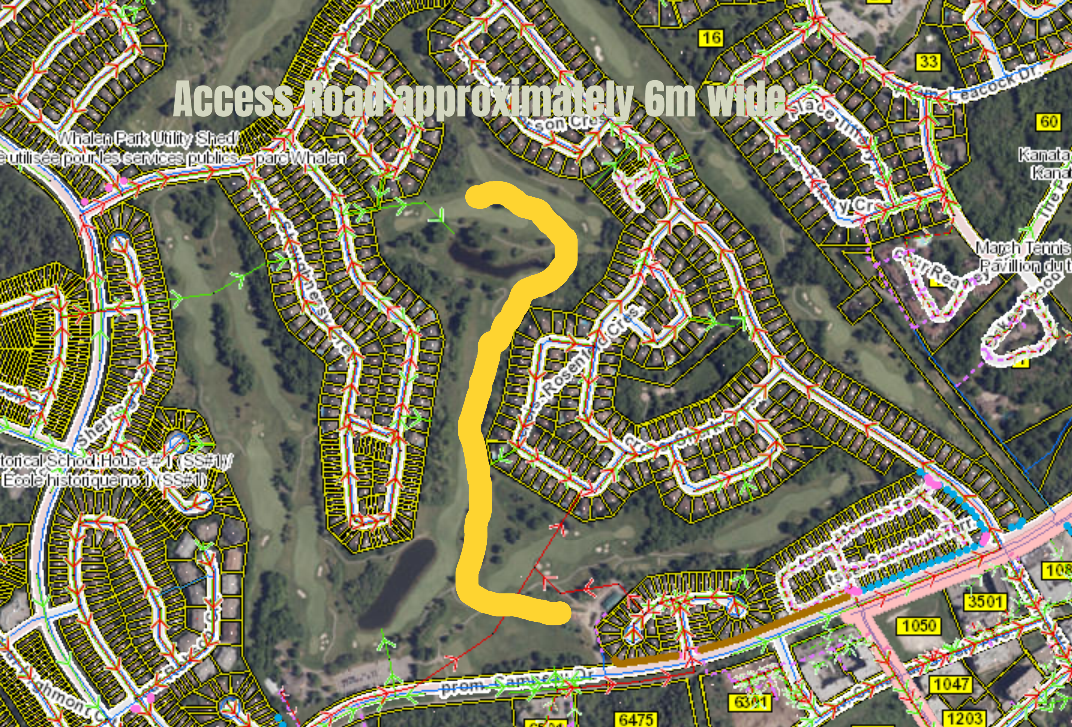
On the morning of January 23, 2026, heavy equipment (a bulldozer) was seen travelling across the golf course property. The “work” involved snow clearing and establishing access for soil and environmental monitoring. I was very upset by this work being carried out with minimal notice received. You can read my statement online here. However, the developer has the right to do testing as per the conditions they will have to meet.
How can any work be done on the golf course lands if earth will be disturbed and we know that the earth is contaminated with mercury?
Both Public Health and the Ministry of Environment, Conservation and Parks have been contacted by the City of Ottawa regarding this concern. Community concerns have been registered, and City staff are committed to ensuring that testing is carried out within the regulations. Know that further clarification is coming on this topic.
Aren’t there covenants that “run with the land” still in effect on this property?
Yes. They can be read here. And, yes, they are still in effect.
How can any earth be disturbed when the covenants seem to restrict that?
The covenants speak to disrupting drainage patterns and grading. A test hole can be dug without disrupting drainage patterns and grading.
Is anyone monitoring this testing?
Yes. The City’s Planning Department has sent out Inspectors (Inspections Staff) to monitor what is going on on the site. The City Inspector called me and told me that he has been on site every day, has spoken to the representative from Minto to get clarification, and is watching this work carefully.
This is what we received last week from staff who are inspecting the site.
“Site Visit
Date January 28, 2026, 8:30am
Completed a site visit and walked the site
- No activity on site
- Temporary Road has been plowed as per the attached sketch. Surface snow removal only with no soil disruption.
- Talked with [Minto staff member] and he confirmed that the snow removal will be completed today, and the access road was plowed to provide access to start soil monitoring and per investigation Geotechnical work.
- This is being done to install ground monitoring systems to measure any contamination
- Expect to see rigs on site to install the actual systems in the coming days
- While this will be done under the supervision of a Geotech engineer, and typically no City supervision is mandated, City staff can attend the site regularly”
Shouldn’t there be an independent third party doing the mercury testing to be sure that the developer doesn’t influence the results in their favour?
Both Public Health and the Ministry of the Environment, Conservation and Parks have both been contacted for their awareness and to determine their oversite roles.
I have been in contact with the City’s Manager of Planning, and he has told me the following:
“This type of work would be undertaken with direction from Professional Engineers(P.Eng) and/or Professional Geoscientists (P.Geo) working for ClubLink. They would be considered ‘Qualified Persons’ and would have certain responsibilities and obligations under the Environmental Protection Act, as well as the Acts governing their respective professions.”
Have our community associations been advocating on this file?
Yes. The KBCA has sent in multiple letters to City staff regarding soil contamination and flood risk . The KLCA President and KBCA President are both part of the KGPC and are bringing resident concerns to the KGPC.
How can I follow any advocacy efforts by the Kanata Greenspace Protection Coalition (KGPC)?
You can follow the KGPC by signing up for their e-newsletter at KGPC eNews. And, you can go to their website at Kanata Greenspace Protection Coalition. One of their most recent letters regarding the mercury contamination can be read here.
Has the Kanata North Business Association (KNBA) or the businesses in the Tech Park advocated to save our greenspace?
Yes. Both the Kanata North Business Association (KNBA) and individual companies have written letters to Premier Doug Ford and Minister Vic Fedeli to ask them to do everything in their power to support the Mayor and the City of Ottawa in their efforts to save our Kanata greenspace.
How can I stay informed about this file?
I will be sharing updates as they become available. You can read them online on my website and also sign up for my community newsletter to receive updates directly in your inbox.
As always, I’d like to thank you for everything you’ve done over the years, with a special shout out to the Kanata Greenspace Protection Coalition and their leader, Barbara Ramsay.